Britain’s Pay Packet Is Back — the Market Still Thinks It’s a Fad
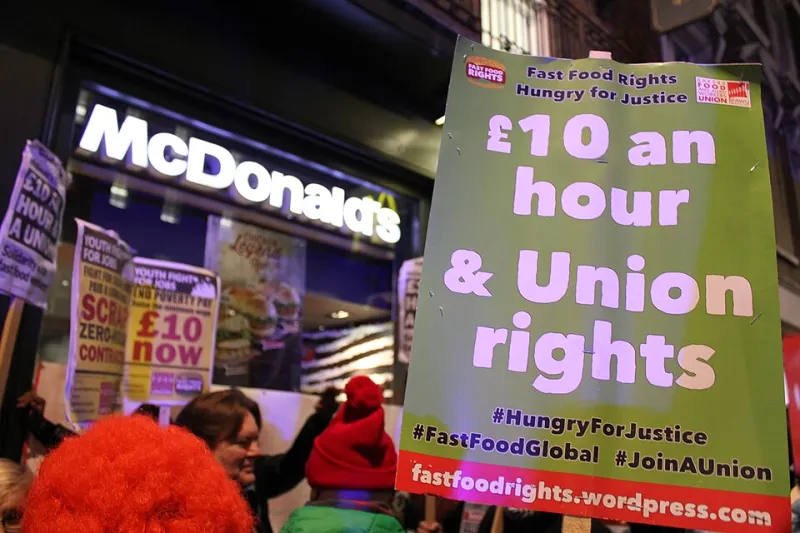
Photo: War on Want, CC BY 2.0, via Wikimedia Commons
For almost two decades, UK real wages were the economic equivalent of a stuck lift. Everyone knew it should be moving. Everyone could hear the machinery. It just did not go anywhere useful. Only recently has the average pay packet clawed its way back to where it was before the financial crisis. That is a remarkable fact, and an uncomfortable one for anyone who assumes the UK consumer is permanently broken.
The market, meanwhile, is still positioned for a wage fad. The consensus view is that pay growth must cool, that the labour market is softening, and that the Bank of England can settle into a comfortable cycle of easing. Maybe. But the assumption is doing an awful lot of heavy lifting in portfolios. If UK wages have found a floor — not a spike, just a firmer floor — then the winners and losers inside the FTSE are not where the crowd is looking.
The consensus trade is a wage cooldown
You can see the logic. Inflation has been the story for years. Policymakers want proof that pay pressures are easing. Companies want to believe that labour costs will stop surprising them. Investors want the clean narrative: wages cool, inflation falls, rates come down, domestically exposed stocks re-rate. It is a tidy story. Tidy stories are often crowded.
The problem is that the UK labour market has not been tidy for a long time. Vacancies have come off their extremes, but they remain high relative to the number of unemployed people. Economic inactivity is still a structural issue, not a cyclical blip. An ageing population is doing what ageing populations do: shrinking the pool of workers. Whatever your view on migration policy, the direction of travel has become a political variable, not a reliable labour-supply tap.
And then there is the wage floor. The National Living Wage has been uprated aggressively, and the political consensus around a higher minimum wage looks sturdy. That does not just affect the people on it. It compresses pay scales, pushes up supervisory wages and changes the economics of every labour-intensive business in the country. A higher wage floor is no longer a policy accident. It is architecture.
Why the UK wage floor is harder than it looks
Markets are fond of treating wage growth as a simple cycle: too hot, then too cold. But the UK has spent the past few years discovering that supply matters. If there are fewer workers, and the ones you can hire have more bargaining power, then wages do not need to boom to stay firm. They just need to stop falling behind.
Companies can respond with automation, productivity improvements and clever scheduling. All of that takes capital, time and management attention. In the meantime, the labour-intensive parts of the economy — hospitality, care, logistics, retail, food processing — face a simple arithmetic problem. Their revenue may be rising, but their wage bill is rising too, and it is harder to pass on costs when your customers are also feeling the pinch.
That is the part the consensus underplays. A firmer wage floor is not uniformly bullish or bearish. It is a redistribution. It puts more money in the pockets of people who spend a high share of their income. It puts pressure on the margins of businesses that rely on low-cost labour. The market often lumps ‘UK domestics’ into one bucket. That bucket is about to get a lot more differentiated.
Where the early signals are hiding
If wage growth is genuinely cooling, you should see it first in the flow data, not the headlines. Watch vacancies relative to unemployment. Watch the ONS PAYE data for signs that hiring is slowing rather than just pay growth. Watch services inflation, because it is the line most sensitive to domestic wage costs. Watch the REC/KPMG jobs surveys for the gap between starting salaries and permanent placements.
Then listen to company calls. When management teams start saying ‘labour availability’ rather than ‘wage inflation’, the pressure may be easing. When they start talking about ‘ productivity’ and ‘automation’ with a sense of urgency, the pressure is still there. The early signals are rarely in the big macro numbers. They are in the small print of trading updates.
One useful indicator is the relationship between pay growth and services CPI. If pay is still firm but services inflation is falling fast, companies are absorbing costs. That is a margin story. If pay is firm and services inflation is sticky, companies are passing costs on. That is an inflation story. Either way, the consensus ‘wage cooldown’ trade looks less comfortable.
The portfolio side: own the tills, not the tables
A structurally firmer wage floor changes the winners inside the UK market. Domestically focused consumer stocks with pricing power and exposure to wage-earning households should benefit if real incomes keep recovering. Think of the businesses that sell everyday essentials, value-led retail, and consumer services where volume matters more than luxury margins. If the UK consumer is finally getting a pay rise that sticks, the market may still be underestimating the breadth of the recovery.
On the other side, labour-intensive margins deserve more scepticism. Pubs, restaurants, care homes, logistics operators and thin-margin retailers cannot simply wave away a higher wage bill. Some will automate. Some will consolidate. Some will discover that their pricing power was always weaker than they thought. The market has spent years rewarding ‘defensive’ businesses without asking whether their defence relies on cheap labour.
This is not a call to buy every UK consumer stock and short every pub company. It is a call to stop treating wages as a one-way macro variable. The UK is not Japan. We are not stuck in a permanent deflationary grind. Real wages have only just recovered from the financial crisis, and the labour market has structural tightness that will not vanish because the Bank of England wants it to.
What would prove this wrong
A productivity boom would change the maths. If AI and automation suddenly allow labour-intensive businesses to do more with fewer people, wage pressure could ease without a recession. A surge in labour supply — through migration, participation or a health miracle — would do the same. A sharp demand shock would also cool wages, but it would not be good news for the consumer stocks that benefit from them.
So this is not a dogma. It is a probability shift. The market is priced for a wage fad. The data looks more like a floor. That is an uncomfortable combination for consensus portfolios, and an interesting one for anyone willing to look at the UK domestically exposed market with fresh eyes.
The contrarian trade is not to bet on runaway wage inflation. It is to recognise that the UK pay packet has finally recovered, and that the market’s assumption of an imminent cooldown may be the wrong side of a structural shift. Own the businesses that benefit from workers with more money in their pockets. Avoid the ones whose margins depend on workers having less.